

The short answer: despite the names, cultured marble is mostly plastic and quartz is mostly stone. Cultured marble is roughly 75% polyester resin with about 25% crushed marble dust. Engineered quartz is the reverse — around 90–93% ground natural quartz bound with a little resin. That one fact explains every practical difference: cost, heat tolerance, how each fails, and whether damage can be repaired.
For a bathroom vanity, cultured marble is cheaper and can be moulded seamlessly with its sink. For a kitchen worktop or a table top, quartz survives daily use far better.
The numbers that decide it
| 75% / 25% | Cultured marble: polyester resin to crushed marble dust |
| 90–93% | Engineered quartz: proportion that is ground natural stone |
| 300 °F (150 °C) | Where quartz resin begins to scorch |
| 660 °F (350 °C) | What natural marble tolerates, for comparison |
| $60–100/sq ft | Typical installed cost of quartz |
| 98%+ | Calcium carbonate content of commercial marble dust |
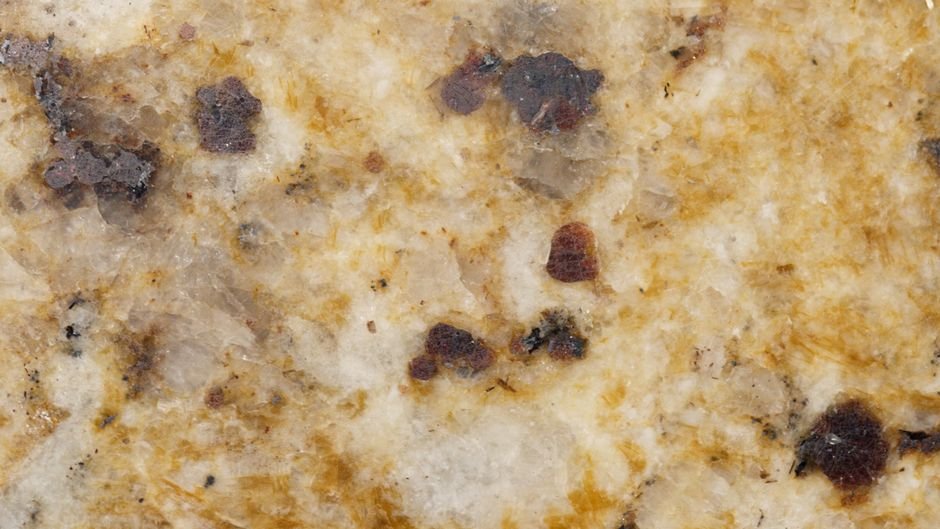
Cultured marble vs quartz at a glance
| Cultured marble | Engineered quartz | |
|---|---|---|
| What it is | ~75% polyester resin, ~25% crushed marble dust | ~90–93% ground quartz, remainder resin |
| Surface | Gel coat — a thin sprayed layer | The material itself, all the way through |
| Made by | Poured into a mould, then cured | Slab pressed under vacuum and heat |
| Heat limit | Low — resin softens and yellows | Resin scorches above ~300 °F (150 °C) |
| Needs sealing? | No, while the gel coat is intact | No — non-porous |
| Typical cost | Below quartz and natural stone | $50–200/sq ft; commonly $60–100 installed |
| Seams | Often none — moulded in one piece | Visible seams on runs wider than a slab |
| Repairing damage | Polish light marks; deep damage needs re-coating | Professional colour-matched fill |
| Best for | Vanities, shower surrounds, integrated sinks | Kitchen worktops, dining tables, coffee tables |
What cultured marble actually is
Cultured marble is a cast polymer. Manufacturers blend unsaturated polyester resin with crushed marble dust — commercial marble dust is at least 98% calcium carbonate — add pigment, then pour the mixture into a mould. Air is vacuumed out first so bubbles do not set into the piece.
Proportions vary by manufacturer. A common blend runs about 75% resin to 25% crushed stone, though some formulations use closer to 40–60 parts resin by weight. Fillers other than marble dust appear too: silica sand, aluminium trihydrate and glass frit are all used.
The purpose of the gel coat is to provide a glossy finish and assist in making the final product waterproof.
ARSTAR, on the cultured marble manufacturing process
That gel coat is the part you actually touch — a clear or pigmented polyester layer sprayed into the mould before the resin goes in. Everything cultured marble does well, and the way it eventually fails, comes back to it.
What engineered quartz actually is
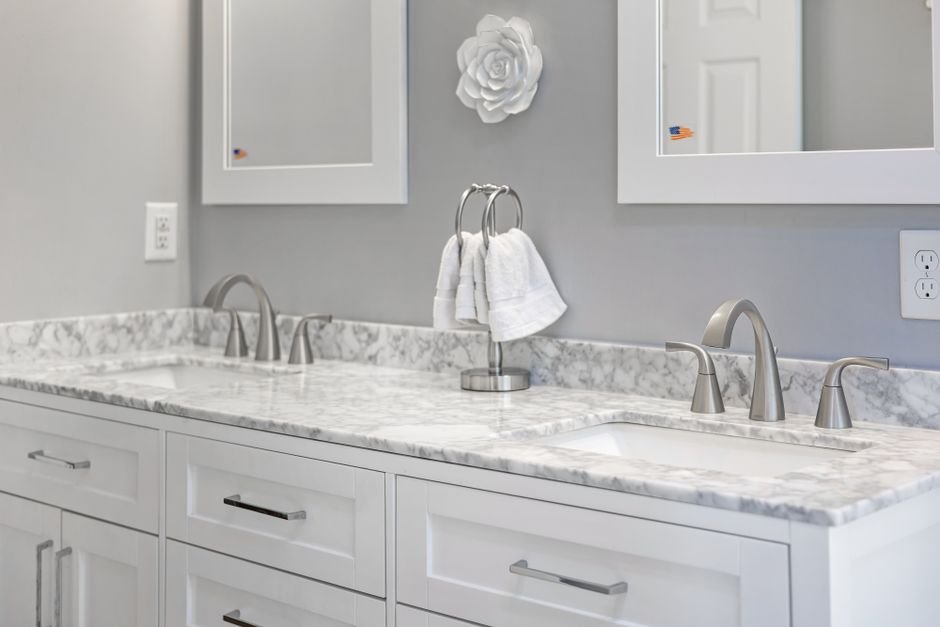
Engineered quartz inverts the recipe. Ground natural quartz — one of the hardest common minerals — makes up roughly 90–93% of the slab, bound with polymer resin and pigment, then compacted under vacuum and heat into a solid sheet.
Because the stone content is so high and consistent through the full thickness, quartz behaves like stone in daily use: hard, non-porous, resistant to staining without sealing. The resin is a small fraction of the mass, but it is the weak point — it is what caps heat tolerance. If you are weighing quartz against the real thing, see our full quartz vs marble comparison.
See how cultured marble is made
The differences that matter in a real room
Heat: both are vulnerable, for the same reason
Neither is natural stone, so neither takes a hot pan. Quartz resin begins to scorch above about 300 °F (150 °C). Cultured marble, carrying far more resin plus a thin surface coat, gives up sooner — heat marks show as yellowing or a dulled patch in the gloss.
Natural marble tolerates roughly 660 °F (350 °C). If heat resistance is the deciding factor, neither product on this page is your answer.
How each one fails — and whether you can fix it
This is the difference nobody mentions and the one you will live with. A scratch in cultured marble cuts through the gel coat into the duller cast body beneath, so it reads as a pale line against the gloss. Light marks polish out with compound; anything through the coat needs re-spraying to disappear.
Quartz is the same material throughout, so a scratch exposes nothing different — and it resists getting one. A deep chip does need a professional colour-matched fill, because you cannot re-cast a slab.
Pattern: both repeat, natural stone does not
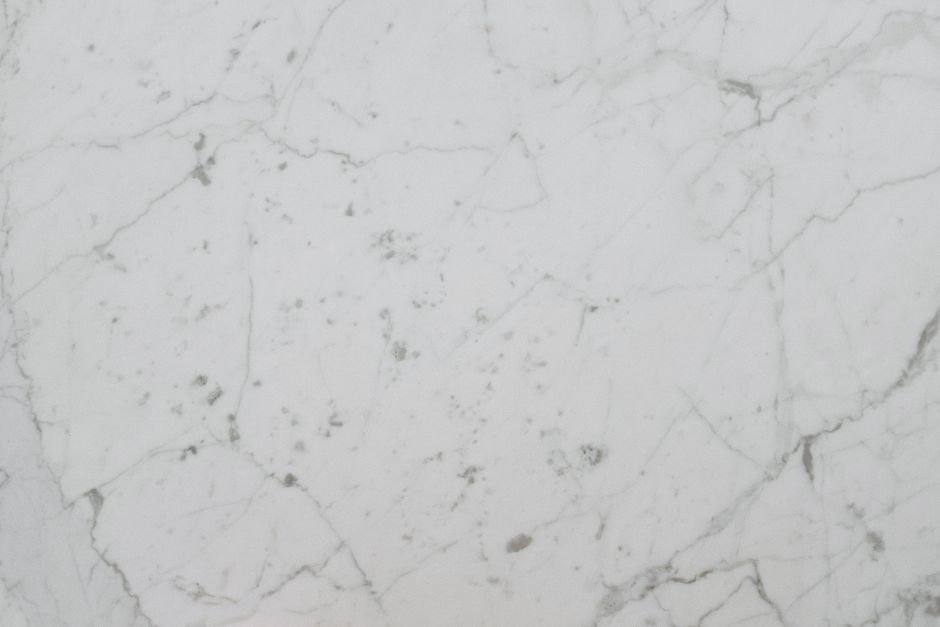
Cultured marble veining is added as pigment during pouring; quartz patterning is set by the manufacturer’s recipe. Both repeat across pieces. Natural marble does not — every slab is different, which is the reason to pay for it.
Which should you choose?
- Cultured marble — bathroom vanities, shower surrounds, anywhere you want an integrated moulded sink with no seam. Cheaper, waterproof while the coat is sound, and bathrooms rarely see damaging heat.
- Quartz — kitchen worktops, dining tables and coffee tables. The higher stone content buys a harder surface that shrugs off wear which would dull a gel coat.
- Neither — if you want veining unique to your piece, or genuine heat tolerance. Both are manufactured; their patterns repeat.
Frequently asked questions
Is cultured marble real marble?
Partly. It contains crushed natural marble dust, but only around 25% of the mixture in common blends — the rest is polyester resin. It is a cast polymer product, not quarried stone.
Which lasts longer, cultured marble or quartz?
Quartz, in any high-use setting. Its hardness comes from being over 90% stone, whereas cultured marble depends on a thin gel coat that dulls with wear. In a low-traffic bathroom the gap narrows considerably.
Can you put a hot pan on either?
No. Quartz resin scorches above roughly 300 °F (150 °C), and cultured marble tolerates less. Use a trivet on both.
Does either need sealing?
No. Quartz is non-porous thanks to its resin binder, and cultured marble is sealed by its gel coat. Natural marble is the one needing periodic sealing.
Is cultured marble good for a dining table?
It is a compromise. A dining top takes plates, cutlery and hot dishes daily — exactly the wear a gel coat handles worst. For a table, quartz or natural marble holds its finish far longer.
Sources
- Multi-Tech Products — cultured marble technical composition
- ARSTAR — how cultured marble is made, mould to finished product
- Marble.com — quartz countertop pricing and labour
- MSI Surfaces — marble and quartz cost comparison
Choosing between surfaces is the first decision of several. The full picture, including which piece to buy and how to care for it, is in Marble Furniture: The Complete Buyer’s Guide.